Tweeting Out Loud

    follow me on Twitter

    Tuesday, March 23, 2010

    An Argument for Dedication

    How many things do you rely on your phone to do? On top of making calls, sending text messages, gathering emails, we expect our phones to wake us up, remind us of tasks and remember all of our friends' phone numbers, addresses, emails and screen names, even take care of our Facebook and Twitter accounts; that's a lot of responsibility for one device! But this seems to be the trend; with modern technology booming, and consumers eating up every advancement, dedicated devices are thought of as underachievers. Why have a machine that does just one thing, when technology can allow it to do 12 other things as well? Is more better?

    Steve Jobs has said that people wouldn't be willing to pay for a dedicated device and that "general-purpose devices will win the day." Mr. Jobs may be onto something, but with the recent surge of Kindle, Nook and GPS sales, one may start to think "Why do we want a device that only displays e-books, when we can have one that can surf the web, play music, make calls as well?" My answer is simple. No, really, I mean it. Why would I want an e-book reader? Because it's simple. It provides me with the leisure of reading and lets me escape my world, which is already connected via phone, email, text, twitter, facebook, myspace, et cetera, et cetera, et cetera.... I don't need twitter to push my @replies while I'm on chapter 7 of Alice in Wonderland...

    I love my iPod and my smart phone, but I still want that dedicated device. It's nice to have a GPS in my car that I can rely on to do its one task. It's great to have a blender that does just that. My blu-ray player works just fine without connecting to the internet. These devices are not inferior, for the most part, these dedicated devices perform their functions better than the multipurpose ones. Multitasking is great, but we don't need it for everything. Imagine a world where your phone had a corkscrew built into the top, or if your computer mouse also stapled documents.... Nifty, but a little ridiculous.

    Much to a similar tune, I think we can get lost in our wine and expect it to do too much. Wine already provides us with such a rich myriad of textures, flavors, memories. But some winemakers want more; they manipulate the fruit, the process and the art and sometimes it comes out confusing and overly-produced, much like a musical artist who relies on effects rather than talent. Like our dedicated devices, I feel that we should care less if these wines were made with steel barrels or grown in space. We should focus more on the grapes; the fruit should really shine and dictate the wine, not its process. (I know this is a pretty far stretch, but just my two cents.) It will be hard for you winos, but try this: next time you drink, forget the tasting notes, the charts, the reviews. Turn off your cellphone, forget the tweets and the wine apps; just enjoy the moment. I'm positive, like reading a good, simple book, that your experience will be just as enjoyable.


    How many of you wouldn't be able to go a day without your iPhone? Maybe you know that a more complex wine-making process results in superior wine? Let me know what you think!

    Love and Cheers,

    -Tatum

    Read More!

    Digg this

    Thursday, December 17, 2009

    The Best Wine "App"

    iPhones, Blackberries and Droids are being sold at a record speed and these smart phones are quickly digitizing the way we carry on day-to-day business. One of the nifty things about these phones are the applications that can be downloaded to them for a variety of functionality, connectivity and just plain fun. As a passionate pursuer of wine, I'm more than positive you guys with smart phones have ventured into a couple of apps for wine.

    There is a myriad of apps that do everything from comparing prices, aggregating ratings and providing reviews and suggestions.
    I've explored a few of my own, both purchased and free downloads, and originally wanted to write a post reviewing a couple I got to experience, to help you make a better choice in wine apps. But, after a few weeks of road tests, I just want to reflect on how useless these really are. Wine apps boast their ability to turn you into a connoisseur, hunt down the best prices, find the best rating, suggest the best pairing and everything in between. But the best app isn't on your smartphone and wasn't developed by some programmer; the best app is the staff in the wine store, who will converse with you, get a sense of your taste, the occassion and your interest, and be able to show you the wine that you need. (Or in some cases, never knew you wanted!)

    Okay, so I'm being a little dramatic; not all apps are useless. We all want to save money and the apps that help me assess and compare QPR are the ones that I found most useful. But please take heed; these apps are only tools for helping you choose that perfect bottle. (I dare say, in wine, there are no perfect bottles, only perfect memories.) They should not make the decision for you. No one should walk into a wine store and shut-out the merchant -- they, above any app you can download, have the best knowledge about what they're stocking, how their bottles are drinking and how it might please you. Consumers have a notion that all wine sellers are trying to get you and make theirs. If you encounter a wine shop or a salesperson like this, please find a new store. One with a knowledgeable staff you can talk to, who want to get to know you and know your palate. This is the connection that is lost if we blindly look up every bottle in consideration on our phones.

    But having reviewed apps for weeks, I thought I might as well share my findings. Across the board, I found that most apps did not deliver. Consumer reviews on all of them were very brief and non-descriptive (not too many people post their tasting notes from their iPhones I assume) and a lot of times the wines being searched were not present in the databases. Most of them claimed to be able to do a lot of things, but rarely delivered. I found a lot of apps that were good at one thing but lacked in all other areas. I suppose you could hunt those down and have five different wine apps to go through, but what's the point? A few stood out, in my humble opinion, and were worth noting. Also, please keep in consideration that I used these apps only a few times to get a feel for how they work, so they are not thorough, wine-professional reviews; just me, a normal guy, walking into a normal wine store with some apps trying to buy wine:

    The Wine Ratings Guide by Nirvino -- Apple Apps Store, $2.99 --
    I included this app because of their very impressive and extensive database of wine. I found most of the wines I searched for and their average prices. But I had to say that the app name is a bit misleading; The ratings are on a five-star scale and there are no consumer reviews, which sort of make the app useless unless you just want to find the average asking price. Sort of expensive for a one-trick pony.

    Wine Snob by 9mmedia -- Apple Apps Store, $2.99 --
    Although the database seemed very limited (only 2 of the 12 wines I searched in the store came up) I had to add this because of its cool Geotag feature - every wine entry is logged through Google Maps with GPS Coordinates so you can literally trace your wine. The reviews were not very useful, and it does let you put in your own tasting notes... So, it's nifty and different, but not too great at the wine part...


    R-Vintage Lookup by REGARD Solutions Corp. -- Blackberry App World, $3.99 --
    I was disappointed to find no apps on the Blackberry that really was worth this post (if this post is worth anything at all...) but I did find this useful app. As the name suggest, R-Vintage shows you vintages, varietal, region, 100-point rating and a drink or hold status. This was helpful to me to see what years were good and helped me to stray away from some bottles that they came from less than preferable years. The layout was simple but again, this is a one trick pony; it doesn't have reviews, you can't see individual bottles, so at four bones, this was a disappointment...Way too expensive for what it offers.

    Those were just a few of the many I road-tested. Here is a list of the rest --
    Apple App Store:

    Wine Ph.D
    Wine Pad 2
    Wine Enthusiast Guide

    Blackberry App World:
    Wine of the Day
    10 Top Wines
    Nats Decants Wine and Food Matcher


    I wonder, has anyone tried any of these apps? What were your opinions on them? Do you have a wine app you use frequently? Please comment and school me!

    As you can tell, although most apps did offer some helpful tools, an all-in-one app that can satisfy my need for consumer reviews, QPR, extensive databases and the ability to understand my palate, my personality and my wine-curiosity has not been developed... yet. Until then, I think I'll try the un-digitized version of finding quality wine; Stacy, a knowledgeable and helpful staff member at the local store :) Thanks for your time!

    Love and Cheers,
    -Tatum
    Read More!

    Digg this

    Monday, December 14, 2009

    Help Out Without Really Trying!

    We all can be better people. I like to think that if work, school, responsibilities and all that life throws at us permitted, we would all be more charitable beings, able to give endless volunteer hours to groups, run endless miles-of-tribute or donate more money to whoever needs our helping.

    Ever since performing as the Ghost of Christmas Present (thanks Lori!) in my 7th-grade production of Dickens' "A Christmas Carol," I've always wanted to be a better giver, Ebenezer Scrooge-style. Even though it is trending due to the holiday season, that story always gets me to the point of near-tears no matter what adaptation or revision it is, be it a Jim Carey-CGI-animated blockbuster or a knockoff-Tori Amos-ABC Family adaptation.

    So why should you care? Charity and my middle-school theater roles have nothing to do with wine or technology (although I beg to differ.) I'm posting this because of a site that Natali Del Conte of CNet has brought to my attention; nonprofitshoppingmall.com. Non-Profit Shopping Mall is a great way we can all give back this holiday season while we select the gifts we will be sharing with our loved ones. The best part is, you don't need to do anything extra but click!

    Non-Profit Shopping Mall works on a commission base, where each retailer listed gives a little percentage to an organization of your choice. Why is it so great? Because EVERYONE is in there. All the retailers you would have looked at anyway are there, from Bestbuy to Amazon.com, Nordstroms, Target, Gap, Home Depot, get the point? None of their prices are marked up in anyway. The best part about all that is you can give to a charity of your choice, and there are tons listed, including the Children's Miracle Network, ASPCA, American Heart Association, UNICEF and so much more. So you literally just shop and the big corporations (not you) donate the money and you do nothing you wouldn't have done in the first place!

    Please, I urge you all to consider this option as Thanksgiving weekend comes to an end our holiday season starts to gear into full-swing, and please consider it every time you shop online. What a great opportunity for us to give back and better fulfill our social and ethical responsibilities to be better people.

    If you have trouble deciding who you want to support, please consider Toys for Tots or the Children's Miracle Network, which are my top choices. This December 18-24 I will be dedicating most of my time volunteering for Toys for Tots through my unit in D.C. It will be grueling work, but just knowing that a child who wouldn't have gotten anything from "Santa" will this year makes it all worth it :)

    Happy Holidays everyone, and please shop at nonprofit until you drop (or your wallet goes pop!) The link is provided below for you to explore this wonderful way to share your wealth and give to others who really need it.

    http://www.nonprofitshoppingmall.com/

    With Love and Cheers,
    -Tatum
    Read More!

    Digg this

    Saturday, December 5, 2009

    Beer from up There


    Sapporo, the Japanese brewery you may be familiar with if you frequent sushi bars in your area, has announced the release of their new "Space Barely," which uses barely that has been grown on the International Space Station... Yes, in Spaaaaaaaaaaace!

    I was super excited to try this out when I heard about it, but it doesn't look like I, and most likely you, will be able to anytime soon. According to them, you must be one of the extremely lucky 250 winners who are drawn from a lottery. If you are selected, you get to pay $119 for a six-pack, limit one-per-lucky-winner... That's almost $20 for one beer... Sweet... So yeah, you have to win first, then you get a chance to buy some high-priced six-pack >.<

    The barely was harvested from the ISS space station as part of a five-month space mission that experimented with growing crops in space.

    Here's a Reuters video-press release linked below if you want to take a peek of it yourself:
    http://www.youtube.com/watch?v=TXKa1EV1J4Y

    Does this intergalactic barely have any affect on the beer? Maybe they used martian water and moon yeast to brew it? That will be something we have to wait to find out. If you are lucky enough to get one of these beers, please chime in and tell me how it is. (And feel free to send a sample.) Until then, I think I'm going to try to secure a few cases of Brooklyn Brewery's Black Chocolate Stout before they run out!

    With Love and Cheers,
    -Tatum Read More!

    Digg this

    Saturday, November 21, 2009

    Baby Steps

    Growing up is far from a generic term for "becoming an adult." We all grow up in different ways, through different processes. Even once we are "adult," we keep growing; we can't stop that part of our lives.

    I've started and restarted DeRanter many times in the year-or-so it's been created. I've come to the realization that I was too ambitious; here I was, a young writer and oenophile, who wanted to be like the greats. There's nothing wrong with ambition and goals, but we must know where we are in terms of achieving these goals. I wanted something that can bring wine and technology together; nothing original on my part, but something that genuinely interest me. But I came on too strong, too fast. It became work instead of interest. But as I've spent time away from DeRanter, I've learn to grow and realize how I, personally, achieve my goals. It's not by jumping right in. It's by research, reading and self-induced excitement on the subject.

    I'm no longer concerned about being a "well-educated wine guy." Truth is, I'm not. (Obviously! :P) But I will try to become a writer with interest. Hopefully interest the same as yours. I want to try to convey this through tech-news and wine issues that I fully research and understand and really delve into. I can't promise anything regularly; with my hectic school, work and rehearsal schedules, finding motivation to write can be daunting. I can't even promise a unique approach to this whole wine-tech-blogging thing; I can only promise my approach to it, and hopefully this approach will be unique and interesting enough to keep you reading. So please, come back for more!

    Cheers,
    -Tatum Read More!

    Digg this

    Wednesday, October 28, 2009

    Biodynamic Wine: A first look

    I wish I could go back in time to ask winemakers of past, "How do you think wine making will be affected by future technology?" They surely wouldn't know about our advances in computers.They might not mention the use of modern wine making trends like steel barrels, micro oxygenation, ultra-sound, computer chips in vineyards or extreme temperature control to make cheap wines palatable. However if I were to explained the new Biodynamic Wine trends sweeping the globe, they would think we have regressed back to medieval agricultural traditions!

    For those not familiar with biodynamic agriculture, let me give it to you straight from the Wikipedia article: "Biodynamic agriculture, a method of organic farming that has its basis in a spiritual world-view , first propounded by Rudolf Steiner treats farms as unified and individual organisms emphasizing balancing the holistic development and interrelationship of the soil, plants, animals as a closed, self-nourishing system."

    What this means is the vineyard is considered in it's entirety as a living thing and seen as an organism in it's own right, but one that is in consistent with lunar and cosmic patterns and rhythms and not merely a substrate for plant growth... Wheew...

    Wine makers are taking weird, unconventional methods of viticulture and wine making and following a strict biodynamic calendar of harvesting, planting and etc. because they believe it will help their vines and ultimately their finished wines. These methods are broken up into several preparations that all seem a bit odd and skeptical. Such examples include Preparation 500 where cow manure is buried into the soil for a period of time, dug back up and spread over the fields. Other examples include fermenting yarrow flowers in a deer's bladder or oak bark in a skull of a domestic animal and applying them to compost or spraying the vines with horsetail tea, according to the biodynamic calendar. Weird stuff you thought you'd see on Taboo, huh?

    But what definitely has the world in shock and awe is that no matter how medieval, superstitious or unreasonable these methods seem, the winemakers (all notable and renown in the wine making world) are producing outstanding wine with biodynamie. These producers include Domaine de la Romanee Conti, Zind Humbrecht, Huet, Beaux Freres , and Benziger among numerous others. (For a list of more producers check out http://www.wineanorak.com/biodynamic3.htm) I think what really has people going is because there is almost no way to prove this advantage scientifically... They just seem to be better. Here's an excerpt from wineanorak.com that sums up the whole thing:

    Despite these problems, proper studies have been carried out, and generally they seem to suggest that biodynamics really does work. In 1993, Reganold and colleagues compared the performance of biodynamic and conventional farms in New Zealand, a report published in leading scientific journal Science. They found that the biodynamic farms had significantly higher soil quality, with more organic matter content and microbial activity. In 1995 Reganold published a review of the different studies that have examined biodynamics and have met basic standards for scientific credibility. The conclusion was that biodynamic systems had better soil quality, lower crop yields and equal or greater net returns per hectare than their conventional counterparts. But what could the mechanism be? A tantalizing clue is offered by some experiments carried out by a graduate student of Reganold’s, Lynne Carpenter-Boggs, on the effects of biodynamic preparations on compost development. In an experimental setting, biodynamically treated composts showed higher temperatures, faster maturation and more nitrate than composts that had received a placebo inoculation. Reganold is clearly impressed: ‘Of all the farm systems that I’ve seen, biodynamics is probably the most holistic.’

    As I conclude I will state that biodynamie on vineyards does work... They seem to produce greater environments, grow superior grapes and make tastier wine. The hard thing to conclude is why does this all work? Ancient civilizations have planted, harvested and celebrated with the phases of the moon and the cosmos for centuries. Perhaps there is something there? Perhaps it is some sort of spiritual, holistic reason for this all to make sense. Or perhaps it's just with biodynamic procedures, wine makers are paying close attention. They are giving their land, their resources and their environment the attention it deserves; the close attention and observation that is needed to produce superior wine. That's something this world could never have too many of; devoted, passionate and dedicated wine makers who "listen" to their vineyards. For further research on Biodynamic wine I urge you to google up on the subject and be sure to check out http://www.wineanorak.com/biodynamic1.htm for a great resource on the subject.

    Cheers to you,
    -Tatum
    Read More!
    Digg this

    Friday, December 5, 2008

    DeRanter's first Tasting Note... a beer?!

    I posted this on the WLTV forums and I thought I'd share it on DeRanter as well. Why not, right?

    This will be my official first beer tasting note... well actually, on this site, this will be the first tasting note of anything. Who knew that my wine blog's first tasting note would be of a delicious beer? Go figure...

    A note on tasting notes; I usually try not to publish tasting notes myself. I take the side that the great Tom Wark, from Fermentation Wine Blog, takes; I leave the tasting to the ones that are good with it. Yes, I taste wine, but there are people that can be much more expressive, detailed and intricate than me. I'm just starting out... But I realized, I might try to post a few up here anyway. If anything, it will help my writing skills, and maybe I'd get a critique or two from my readers. (Wink, wink...)

    I decided to buy a six pack of Brooklyn Brewery's Black Chocolate Stout because I needed a lift. A week of homework, test, group project meetings and just the overall end-of-semester woes. I wanted something to relax me a bit. It was good that I didn't have class today because coming in at 10% alcohol, this is not a school-night drink... well, maybe if you have just one...

    Inky black color with a nice head of foam. It smells great too; roasted coffee beans and a hint of dark chocolate, but that's not it...

    Shwooosh! The cold liquid flows out to cover your mouth with slight bitterness and opens up to reveal a world of roasted almonds (or some kind of nutty component), coffee, and rich, but subtle, dark chocolate. This is quite a filling, heavier stout, and I can see why it's their winter seasonal.

    The finish was star of the show; the hints of charcoal cling to your tonsils until the next sip, and flavors of bitter chocolate, nuts and espresso chill on your taste buds until the last drop. Very delicious beer and one that can truly say, "Eat your heart out, Guinness..."

    A few people have told me that this is not comparable to Guinness, but after review and another sip I feel it is... I might even say that "Guinness" would be a tasting component of this beer. I was very happy, sleepy and relaxed by the end of the night and, after two bottles, was able to drift off to sleep.

    So what do you think? Maybe you might want to go out and try some of this stuff, it's great!

    Cheers to you,
    -Tatum
    Read More!

    Digg this

    Tuesday, December 2, 2008

    It's our wine!... Time, I meant time...

    My generation is a thirsty one, according to multiple sources like the LA Times, NY Times, Winecast and NY Sun. A number of articles have been written, numerous surveys have been tallied and hours of research confirm that the Millennials are taking center stage in the wine world. "They" are saying that our generation is drinking, appreciating and buying more wine at a much younger age than previous generations. So, what's all the hype? Statistics don't have anything to do with wine business, culture and innovation, right? Wrong. We are the future, and with our buying power, our passion and our numbers, but most importantly with our wires, we can bring change to an industry that has thrived for centuries... but will we?

    For readers who are not familiar with what I mean by "Millennial," let me give a quick run-down: "The Millennials Generation" is considered the generation after "Generation X," and definitely after the "Baby Boomers" of post-WWII, whom were born between the 80's and the turn of the century. For the past decade-or-so this generation, my generation, has been turning 21. Among things like not knowing a life without computers and relying on the Internet to do everything, we are the biggest generation to be appreciating wine, and at a much younger age than our parents and grandparents. And at an estimated 100-million strong, we're a big generation! (Compared to 44-million baby boomers)

    I've noticed at my WLTV gatherings that older generations seemed to have discovered wine at a much later age than me. Most people I meet in the wine scene are in their 30's and 40's, not having really appreciated wine until they were 25 or older. I was infatuated with wine knowledge, culture and practices when I turned 20. The only thing I wanted to do when I turned 21 was to buy that official bottle of wine, and sure enough I did, a 2001 Haut-Brion. I didn't care about the bars or the vodka, I just wanted the wine; people like me are sprouting up all across the world. They discover wine for what it really is, not just it's inebriating purposes...

    It has been noted that our generation are not as likely to stick to the "big name" wines. For us, tasting wine is not as much of a class or status issue as before. Gary Vaynerchuk has been shouting to the world what the Millennials believed all along; wine shouldn't be a way to judge your wealth or power. It should not hold pretension and it should be enjoyable and pleasing. We are less likely to choose a wine because of the name of the chateau on the bottle, instead we choose it by varietal or region. We want to explore the world with wine, instead of sticking with the few "good ones." Playing it safe isn't our style; we take more risk, and a bad bottle of wine doesn't disappoint us as much. And don't forget that for most wine choices, we decide based on instant gratification, as with everything else in our modern lives, so we rather pick the $15 mystery malbec then buy Brunello for $80 and hide it for ten years. Does it mean I wouldn't buy a brunello to age? Nope, but sometimes I just want to taste wine now.

    But what is the reason? Has wine become so popular that it's captivating drinkers at an earlier age? Not necessarily. It's the wires; the wires that stretch from country to country, wine maker to consumer and expert to novice. Now with the power of the Internet, wine knowledge is at our fingertips. We need only go to a search engine and type some keyword like "Cote du Nuits" and find pages of wisdom on these regions. This was not as available before, as hobbyist had to either buy a book or go to the library to read up on this. Now, we can gain knowledge without leaving the keyboard.

    Social networks have allowed winos to find each other. Producers can send newsletters and design websites to inform consumers of futures, a novice can link up with a group of seasoned drinkers and learn the nuances of tastings, and winos everywhere can produce blogs, exchange tasting notes, reviews, plan and promote events, among other things. The way that the Internet has changed the wine world is tremendous, and the way our generation will impact it is even more so. In the words of Gary, this generation is "Changing the wine world, whether they like it or not." Because of our broadened cultural understanding, openness to change for the better, and our lack of support for traditions we don't deem necessary, we have already changed things tremendously. We have taken wine out of the glass and into plastic cartons. We have stopped using the corks and using screw caps. Every facet of wine is going to and will change with our technology and intuitiveness.

    But will we change it for the worse? Not really. As our world grows faster and smaller, some might fear that the traditions and history of wine will be lost. I'm sure that will not happen. I'm sure that our great generation will innovate, inspire and dream and make wine their own. Wines will stretch the world over many times with the strength of the Internet and our social-technical intuition. New countries will become "wine countries" and drinkers will benefit from an open-minded, unpretentious and passionate society.

    I feel that my generation will lead the way to writing one of the most important chapters in wine history, while ensuring that the romance, wisdom and love of wine is shared to future generations. May wine live forever.

    Cheers to you,
    -Tatum
    Read More!

    Digg this

    Friday, November 7, 2008

    Wines that will change a life...


    I never really can justify a bottle of wine that cost more than $80 because, quite frankly, I can’t appreciate it yet. My palate, not to mention my wallet, does not have the “chops” it takes to distinguish these wines from my usual $15-$40 “school night” drinkers. But, while catching up on my WLTV episodes, Gary mentioned a wine that I thought maybe someday I could justify buying...


    Gordon L. Holmes, a Wall Street publisher turned wine maker, and Lookout Ridge has gathered an amazing team of wine makers who are producing top-notch wines for a cause worth admiration: wheelchairs. That’s right, for every bottle of wine you buy from them, they donate the profits to Wine for Wheels, an organization that is dedicated to provide wheelchairs to people who can’t afford them.

    Their dream-team cast of wine makers includes Andy Erickson, the wine maker at Screaming Eagle, Greg La Folette, from Tandem, Cathy Corison, Richard Arrowood, Aaron Pott, and so many more prestigious names.

    The winery also delivers a personalized certificate with a photograph of the person your donation went to with the bottles of wine that you buy. Holmes realized the importance of having a wheelchair his wife developed a rare form of debilitating multiple sclerosis.

    Here’s a bit from an article at Bloomberg.com that was written in Febuary that sums up the deal:
    By 2000, Holmes was planting vineyards and hired top winemaker Greg La Follette to help him make wine from purchased grapes. Four years later he met California real-estate developer and philanthropist Ken Behring, who started the Wheelchair Foundation. That chance encounter and his wife's situation inspired his Wine for Wheels effort.


    ``The first time we distributed wheelchairs, in Mexico, I saw how one could instantly change someone's life,'' he says. ``I picked up a little boy whose dad was wheeling him in a wheelbarrow and sat him in a wheelchair. The look on his face now that he could get around by himself -- wow.''

    Holmes, a self-confessed Type A personality, manages his own investment portfolio and also publishes three online newsletters on precious metals and energy.

    ``My uranium stocks have gone up 1,000 percent since 2001,'' he says. He leverages his financial connections to promote Wine for Wheels. Next week, when he attends a mining conference in Toronto, he'll take wine. Not to make money, he says, but to get on the 25,000 attendees' charity lists.

    The winemakers he approached for his project were quick to sign on.
    ``Within 20 minutes of talking to Gordon, I was in,'' Erickson tells me later. ``I've traveled in South America and Asia and seen people with no legs living in boxes, trying to get around on skateboards. My wife and I were looking for some way to give something back.''

    That is the beauty of wine- it’s not hardcore capitalism, it’s not all about the finance and profits, numbers and figures. Wine is about passion, love and companionship. It’s good to see such a talented group of people not only give to their love of wine, but give back to the community. To these philanthropists, they aren’t just trying to make money; they are trying to give to people who deserve more. They are trying to give back dignity, independence and faith. To a winemaker, there could be no greater reward.

    I know the packages are pricey, but take a look anyway: http://www.lookoutridge.com/lookoutridge/page/wine-for-wheels.jsp

    Cheers to you,
    -Tatum

    Read More!

    Digg this

    Thursday, November 6, 2008

    Not "broadbanding" wine anytime soon...

    Barack Obama’s website stated that he “believes America should lead the world in broadband penetration and internet access.” John McCain also believes that everyone, no matter rich or poor, should have internet access. I, and I'm sure you do to, rely on the internet tremendously to get every-day activities done. I have convinced myself that without a computer, my life could not function. Besides that point, we are seeing the information revolution, where everything will be instant, better and faster. All this is due to the incredible medium which is the internet.

    Let me state something painfully obvious; the internet has become common place for the world. Without second thought, we turn to it to optimize, automate and enhance our lives, everything from communication to entertainment. So, it comes to no surprise that the marketplace has shifted from the traditional brick-and-mortar mom-and-pop shops to the web.

    But as we slowly see wine consumers, culture and attention go “Web 2.0,” I’m not convinced that the wine world will see its shift to the virtual tasting room too soon…
    Being a Vayniac, I have seen how Gary has turned his father’s local liquor store into Wine Library, a nationally known brand. He owes, and gives, a lot of his credit to Web 2.0. Numerous other companies have started up on the web to sell wine as well: Winebid.com, Wine Woot, Winestillsoldout.com, the list continues. Things will heat up when multi-million-dollar internet conglomerate, Amazon.com, begins their process to sell wine through their site. These are all good things; we consumers have power to choose, to dictate and to explore far more varieties of sources than ever. From California to France, buyers can find great values and immensely amazing selections with tremendous availability. We can get tasting notes in an instant, share information on blogs and forums and make less pressured, more educated buying decisions.

    If you’ve notice, these are all benefits. I have not listed many problems or criticism to wine going online, because quite frankly, I prefer it. I believe that it is the future, but this future certainly is not within our near future. One simple reason I believe this is because we are human beings. Okay, yes, another painfully obvious statement, but as human beings we need company and experience. We observe patterns, solve problems and learn from our experience, which accumulates into knowledge that becomes wisdom. You drink a lot of wine, you buy a lot of bottles and you will accumulate Wine wisdom. We need company; this is why online social networking has become such a phenomenon, because we can keep and search for friends in more ways than ever before. We want to spend time with each other, our instincts need it. This is why we host wine parties, tasting, and conventions. This is why wine will never be exclusively “broad-banded,” if you will, because it requires that human element to exist.

    Because of this need for human interaction, we will not shift our buying practices to the internet completely. Without local wine stores, there would be no wine sales people. Wine people are as much of a part of our “wine collection” as the bottles themselves. How many of us have a special connection with at least one person who deals with trying to get you to buy wine? They tell us the latest trends, they pull out the super-primo stuff when you stop in and they enjoy selling wine to you; but that’s not something you can do without knowing a person’s tastes, style and character. Automated processes have very limited solutions to this because it can’t “get to know” anything, it can only dictate. A good wine person does not dictate what a “good buy is,” they recommend it and tailor it to the consumer. A wine recommendation is based on personal connection, not algorithms.
    I will always go out to the LWS to browse the aisles, look through the bargain bin and pick up that bottle. I want to go chat about wine news and knowledge, I want to feel the bottle, have those special samples. Broadbanding wines will lose that human element.

    And who is to say that because something is cheaper and more abundant that we will abandon local wine stores? Because I can stream almost any movie for free on my computer doesn’t mean I don’t enjoy a date out to the theaters, or just because I can order food online from almost anywhere does not mean I won’t go enjoy some company at a nice restaurant. In this way, no matter how fast, efficient and connected we become via the internet, the human element will also rule our instincts to be with each other share the company and celebrate friendship.

    Cheers to you,
    -Tatum
    Read More!

    Digg this

    Saturday, November 1, 2008

    Brunello sticks to their roots...

    As many winos may have heard in the news recently, an upcoming vote on the fate of Brunello di Montalcino drew to an end today, and I have the results, thanks to a subscription to vinowire... (You should get it, it's free!)If some readers don't know what I'm saying then let me give it to you in a nutshell:Brunello di Montalcino, a prestigous wine region in Italy, must be made of 100% sangiovese grapes. Around eight months ago, fake "Brunello" blends (read: not 100% sangiovese) were being sold as BdM- This was bad for Italy and bad for brunello. Some wine makers said they wanted to change strict, Italian DOC and DOCG wine laws to allow blends; this will help tailor the taste of BdM to foreign (read: majority American public) consumers who are not used to a power palate-boxer such as brunello.

    So, here are the voting results:

    Proposition 1- Are you in favor of changing the ampelographic (the study of identification and classification of grapevines) basis for Brunello di Montalcino? 662 voted NO, 30 voted YES

    Proposition 2- Are you in favor of changing the ampelographic basis for Rosso di Montalcino? 540 voted NO, 162 voted YES

    Proposition 3- Are you in favor of changing any other appellation rules? (yields, allowing the use of concentrated rectifiede must) 474 voted NO, 278 voted YES

    Proposition 4- Are you in favor of grouping all appellations into a single "Montalcino" appellation? (Except for Sant' Antimo.) 684 voted NO, 6 voted YES

    Proposition 5- Are you in favor of grouping all other appellations into a single "Montalcino" appellation? (Except for Brunello di Montalcino.) 572 voted NO, 118 voted YES

    So as we may see in these results, it seems that wine makers stay proud and true to their traditions. Even though changing some of these DOC/DOCG laws may help business and harvest, the prestige of Bdm and all Montalcino's wine regions are more important than financial gain.

    So next time some aristocratic, wannabe flaunts some expensive bottle at you, or you take a punch to the tongue from a truly bold and powerful brunello, thank the Italian wine makers; for keeping their class, sticking by their convictions and protecting traditions.

    Cheers!
    -Tatum
    Read More!

    Digg this

    Tuesday, October 28, 2008

    Wired to Wine: Rhetoric Questions Galore!

    Now-and-days I find that I am inheritly "wired." I don't mean I have a lot of caffiene in my blood or that I am on a constant sugar-rush, but I mean that I have networked, connected and distributed myself through a myriad of means of electronic webs. Sometimes I wonder, after all the Facebook, Myspace, DeRanter, twitter, email, forums, comments on blogs and youtube, if "there is anything left? On the other hand, I also wonder how much of this stuff that I'm recieving is neccesary? Do I have to read Wired Online everyday? If I don't scroll through the hundreds of RSS Feeds from Google Reader, will there be a consequence? If I forget my cell phone at home one day, can I stay connected? For some reason, society has taught us that we

    need to be wired; we need to be connected to each other. "Without a cell phone, you can't make calls if there is an emergency." Well, how did they deal with emergencies back then? "Yeah, well, without Facebook, you can't stay connected." Do I really need to stay connected to 789 friends? Or maybe it's okay to let some of them go; it's not like we speak at all anymore. Am I just pretending that being "socially-networked" and "connected" is vital, and in reality I am just doing it to feel important?

    Now I speak as an individual, but larger corperations, in this case being wineries, distributors, merchants, etc. have either decided to be completely wired, avoid it and stay in a brick-and-mortar style of business or combine the two; I learned it as click-and-mortar. What are the considerations a winery must make before they do this. There are the obvious benefits- mass advertising, real-time information to consumers, reach to global markets, etc. But what are some of the problems this might face? Is it almost a necessity to have an online transaction component to your local wine store ? Maybe, maybe not. Okay, I'm beating around the bush: what I'm getting at is, like I am spread thin by "connecting" so much, have we been spread thin and spoiled by the internet when it relates to wine? How many times can you say you went out, bought a wine and didn't look it up online somehow prior? Could most of us keep track of excessive cellars if it wasn't for the services of cellar tracker? What was it that made us think that we need these things to be into wine. That is something I'm trying to figure out as well... Please comment!
    'till next time,
    -Tatum
    Read More!

    Digg this

    Tuesday, October 7, 2008

    Wine Maker has it right: Make sure you read the last Paragraph


    I just saw this news story on the NYT website and it sort of made me feel better about wine makers. So often do we forget that wine makers are grueling, working year round, night-and-day to deliver us such an awesome glass of wine. Credits always go to the critics or distributors or that LWS that finds the wine, but how often do you really think about how the wine maker feels?
    Please read on to discover a wine maker who was strongly disappointed when he found out how much his wine was being sold for! Make sure you read the last paragraph!

    Cheers!
    -Tatum

    A Winemaker Sees Red
    By Nick Fox


    Not long after my recent column on Paso Robles zinfandels I got a phone call from Ehren Jordan, the winemaker for Turley Wine Cellars. A phone call from Ehren is always a pleasant prospect, as he is one of the more insightful and articulate winemakers around. But this time he was indignant.


    The problem was not what I had said about his wine, which precedes the usual indignant winemaker communique. In fact, I had really liked the 2006 Turley Dusi Ranch zin, and had said so in print. No, the problem was the fact that we had said the bottle cost $115. As with all wine panel tastings, our coordinator, Bernard Kirsch, buys the bottles through retail sources, and $115 was the price of the wine at Morrell & Company, a high-end New York retailer in Rockefeller Center. Really high-end, in Ehren’s view.

    You see, Turley wholesales the bottle for around $20 and the suggested retail is $40 or so. Now, Ehren is not naïve about how the wine market works. He understands that Turley zinfandels, especially the single vineyard wines, are in high demand. This means that retailers must often look beyond the distributors to obtain bottles, and the extra transactions along the way drive the price of the wine up. A lot of highly sought-after wines flow through this so-called gray market. Nonetheless, he didn’t like it.

    “We pride ourselves on the fact that we try to sell wines reasonably,’’ Ehren said. “When I see it for $115, I think, that’s not what we intended. I don’t buy $115 bottles of wine. And the other side of it is, somebody just made a lot more money than we did, and we put all the time and energy into it.’’

    I spoke with Nikos Antonakeas, the managing director at Morrell, to hear his explanation of the pricing.
    “It’s very simple,’’ he told me. “I bought it from a customer who is on the mailing list who sold it to me for $85. There was nothing else out there, and our customers demand it.’’

    Typically, Nikos said, Morrell would get an allocation of two mixed cases — 24 bottles — of Turley’s single-vineyard zinfandels through Turley’s New York distributor, Michael Skurnik Wines.
    He said those bottles were sold at Morrell’s usual retail markup, which would mean about $45. Not surprisingly, those few bottles sell out very quickly.

    “Unfortunately, we have 240 requests,’’ he said. “So I go to auctions, and private individuals. Some are on the mailing list and they just want to make a buck, and sometimes we say yes if we know the customer.’’
    Demand drives the market, and for wines made in minute quantities the demand is overwhelming, and people for whom money is of little object are willing to pay a lot. It’s why a single bottle of 2005 Screaming Eagle can be found in a New York retail shop selling for $2,500, and why a bottle of Krug Clos d’Ambonnay is selling for $4,500. (By the way, if you think $4,500 is too much for a bottle of Champagne, you’ll be relieved to know I found it at another store for $1,000 less, which in fact was its suggested retail price.)

    In that context maybe $115 is not too much to pay for a bottle of $40 zinfandel. On the other hand, maybe it is. After all, as Ehren pointed out, somebody’s making a lot of money, and it usually is not the producer.

    “I know wineries that have raised their prices when they see stuff like that, and I wonder whether we should be making that money, but we just don’t want to go there,’’ Ehren said. “I think it also engenders the feeling that Turley is really expensive, and it’s really not true. Then they show up at the winery and it’s just a bunch of guys making wine, nothing fancy. That’s who we are.’’

    He said the idea that people are buying his wine as an investment pained him.
    “Investment? We make the wine to drink,’’ he said. “It’s zinfandel, just drink it!’’

    Read More!

    Digg this

    Tuesday, September 23, 2008

    Working the 25th Annual Maryland Wine Festival

    I know what you guys are all thinking; "Maryland wine sucks!" and while not a lot of Maryland wine I drink really appeals to me, but my eyes changed when I worked the Maryland Wine festival in Westminster a week back.

    I worked for Cove Point Winery- a small winery located in Lusby, Md. who is run by Tom and Shannon. Tom has dedicated his whole house to producing the wines they displayed at the festival, with new facilities up-and-coming. I was amazed at his wines! They were light, crisp, approachable. I loved the Bleufrankhish and he had a killer Cabernet/Syrah blend. His wines were very solid.

    The festival was very solid as well. I got free admission for two days of wineing and it was great. Some notable wineries included Fiori Vineyards, with their Italian- approach to making delicious wines (the sangiovese sold me), as well as other wineries/vineyards of note that I need to look back up. On top of free admission, I got a free bottle of wine for both days of work! Without a doubt I picked up the Bleufrankhish. All this, and all I had to do for "work" was to pour wines to festival goers, chat with them about anything and have a freakin' blast.

    All the fun I had this weekend really showed me things I've always been curious about in myself. I never knew if I had the mettle to be in the wine business. It's tough; wine requires dedication, determination and devotion. But last week I realized I had these things, and when combined with my strength, my interest in people, I saw a glimspe that maybe I could survive in a wine society...

    Until next time,
    Cheers!

    -Tatum
    Read More!

    Digg this

    Friday, September 5, 2008

    NYT: Sulfur

    Here's something I read from a NYT article I thought was interesting. Enjoy!
    August 5, 2008

    A trick using a copper penny can work for all sorts of sulfur-related ills. (Photo: David Zalubowski/Associated Press)

    Sulfur
    By Eric Asimov
    My column in Wednesday’s newspaper is on some mouthwatering white wines from Greece, and in the course of our wine panel tasting I ran into a vexing problem that has taken me deeply and perplexingly into the realm of wine and sulfur chemistry.
    It began simply enough. As often happens, particularly when tasting a large number of white wines, especially those that are fermented and aged in steel tanks, I detected in several of the wines the aroma of burned matches.
    If I could offer a hyperlink to this aroma you would recognize it right away – that flinty smell after you strike a match and blow it out immediately.
    Often, but erroneously, that aroma is attributed to an excess of sulfur dioxide in the wine. Sulfur dioxide has for eons played an important role in both preventing the effects of oxidation and inhibiting microbial growth in wine. Judging by the scientific treatises I’ve buried myself in, that’s probably a gross oversimplification of the role of sulfur dioxide. Suffice it to say that, while a few great wines are made without the addition of sulfur dioxide, the chemical is almost universally used throughout the wine world. But, while the matchstick smell is related to sulfur, sulfur dioxide is not the guilty party.
    The issue came up because one of the wines we rejected due to the matchstick smell turned out to be the one Greek white that I have regularly enjoyed at home. In fact, I’ve mentioned it twice in posts, once in the spring, and once last summer. It’s the Thalassitis from Gaia, a white made from assyrtiko grapes grown on the island of Santorini.
    I’ve really enjoyed this wine. It’s got a floral and mineral character, with the faintest suggestion of honey, and it’s not only refreshing but interesting. I wondered why in the blind tasting I was turned off by it. One difference was significant – my two posts were about the 2006 Thalassitis, while the bottle in our tasting was the 2007.
    I knew I had a bottle of the 2007 at home, so one night shortly after the tasting I opened it. Again, the smell of struck matches. At the panel tasting, the smell had not dissipated after an hour of swirling and sniffing, so I decided to decant the wine. Often the smell disappears with exposure to air. But even after decanting and leaving the wine for 10 or 15 minutes, it was still there.
    Now, let’s be clear – the aroma is certainly not harmful. It’s simply off-putting. To understand why it occurs I checked in with Prof. Roger B. Boulton at the School of Viticulture and Enology at the University of California at Davis. Dr. Boulton explained that matchstick aromas are caused by thiols, sulfur compounds that can result from the yeast fermentation.
    When these aromas develop, he said, many winemakers try to solve it by aerating the wine after fermentation is complete. Instead, the aeration converts the thiols into disulfides, compounds that are heavier than thiols and more difficult to eliminate. In effect, the aeration simply buries the aroma in the wine.
    “You’ve converted something that was very volatile into something not so volatile,’’ Dr. Boulton told me. “You think you’ve gotten rid of it, but you haven’t gotten rid of it at all.’’
    Strangely, the aroma thereafter surfaces periodically but unpredictably. Exposing the wine to air — by decanting, for example – can suppress the aroma enough to make the wine enjoyable, but it doesn’t eliminate it. Even with the aroma, the wine is palatable — some people aren’t bothered by it at all.
    “Once it’s in the disulfide form, you can’t treat it,’’ Dr. Boulton said. “The irony is that if a wine is aerated to get rid of it, it just makes it more difficult to get rid of.’’
    While winemakers do not want the thiols to convert into disulfides, also known as mercaptans, it’s beyond this post to explore what can be done about it. Dr. Boulton suggests that winemakers treat the wine immediately with copper sulfate. Of course, that’s after the fact. A fermentation that does not produce thiols is the best solution – but apparently that’s easier said than done. For a more in-depth look at the chemistry issues, Jamie Goode, whose excellent wineanorak.com contains a wealth of information of all kinds, has written this essay.
    So what can the consumer do? Dr. Boulton says copper or silver can both help to eliminate the off aromas. The copper penny trick works for all sorts of sulfur-related ills, from the matchstick aroma to the rotten egg aroma, which is a completely different problem. You simply find a clean copper penny, which is not so easy anymore. Since 1982 (according to wikipedia.com) the American penny is 97.5 percent zinc, with a thin copper plating. Previously, the penny had been 95 percent copper. Simply swirl the penny, even the newer penny, in the wine and the sulfur effect should dissipate.
    Alternatively, you could carry a silver spoon around and use it to stir the offending wine.
    “If somebody sees you they might think you’re weird,’’ Dr. Boulton said, “but it will clear it up.’’
    Read More!

    Digg this

    Sunday, July 27, 2008

    Rockville recieves Gary

    I finally got the opportunity to meet Mr. Gary Vaynerchuk a few weeks ago, before heading off to the Mojave Desert! Gary was doing a book signing at the Rockville Barnes and Noble, and when I heard I had to get something to go down! I immediately contacted Matt Sitomer, a very great guy who was very patient and cooperative with me. He made sure that Gary knew where the party was at after the tasting, with US!

    After many hours calling, searching and visiting possible restuarant locations, and discovering that Rockville sucks and that corkage here does not exist (most owners don't know what the phrase means) I was stuck. I had a cult-celebrity coming to visit, I had promised him a gathering and I got all the Vayniacs excited as well, and I couldn't get a freakin' restuarant! But then Big Brad swept in and saved us and offered his pad.


    Gary being the honorary "G" for TBAG 2.0

    The night couldn't have gone smoother (other than me almost losing Gary in the convoy to Brad's pad...) It was a great, informal, relaxed atmosphere. I suppose Gary liked it because he wasn't the center of focus- people were getting to know each other, we got personal autographs, everyone got to one-on-one with Gary; we could have not asked for a better outing. Thank you Gary for keeping us inspired and for being personable. Thank you to all the Vayniacs who came out and showed Gary that he has a following in D.C. and that it doesn't completely suck, even if it sucks quite a bit...

    Until next time, cheers!
    -Tatum Read More!

    Digg this

    Tuesday, April 29, 2008

    The Path to Passions

    Please excuse me for my hiatus in updating Deranter. School has been getting to me, and I’ve been busy running back between Baltimore and D.C., doing projects, writings essays… Finally, let me take a break from all my responsibilities and derant for a bit…

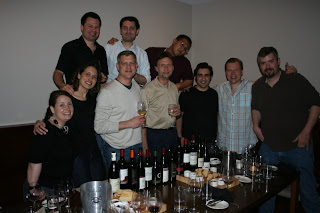
    April 20th was a special day for me. It was the first wine event I’ve ever went to since I turned 21 not more than six days earlier. The gathering was at the Sonoma Wine Bar in D.C. with a bunch of Vayniacs from WLTV. Brad accompanied me to the BYOB; I brought a 2001 Chateau Larrivet- Haut Brion, which was the first legal wine purchase of mine on my birthday. Along with Brad’s 2005 Educated Guess, a Napa Cabernet I believe, there were 11 other bottles! The wine list went:

    2001 Chateau Larrivet-Haut-Brion

    2004 Justin Cabernet Sauvignon Reserve

    2006 Saint Cosme Cotes du Rhone

    2007 Kim Crawford Sauvignon Blanc
    2005 Monchhof Riesling
    2004 Olek Mery Chinon
    2004 Alois Lageder Lagrein
    2004 Zantho St. Laurent
    2006 El Nino Loco Rhone Red
    2003 Adelaida Rhone Style Red
    2005 Querciabella Chianti Classico
    2004 Elizabeth Spencer Cabernet Sauvignon
    2005 Educated Guess Cabernet Sauvignon

    Again, without making this too much of a tasting note, I’d like to point out some wines I enjoyed throughout the night. One of the tasters, Patrick, commented that the Bordeaux I brought was the wine of the night. I loved it as well, as it had a bit of age to it that gave it a nice old-world but still fruit-forward, solid structure. The Elizabeth Spencer Cabernet Sauvignon was amazing as well. The fruit was the star in that wine, and it was a very classic example of winemakers letting the fruit serve its purpose and not manipulating it. The Alois Lageder Legrein was the most interesting of the night; it had a very barnyard nose but a very fruit-forward taste.
    The Kim Crawford SB tasted like Welchs’ Grape Juice to me… Very sweet and not very enjoyable. The Justin Cabernet also seemed a bit of a fruit-nuke. One taster pointed out that the Saint Cosme Cote du Rhone had a “orange peanut circus candy” to the nose- that was the call of the night!
    The experience was fun and amazing. Two full boards of cheese and charcuterie were ordered to accompany the wine. I got a good look at very different styles that night, something that is invaluable to the palate. I got to chat with very wine-knowledgeable people and experience something I know I want to keep experiencing. At 21 years of age, my passionate journey into the wine world has just begun! Cheers!


    -Tatum
    Read More!

    Digg this

    Thursday, April 10, 2008

    A Sunny Day

    Let me start off by declaring that it is a wonderful day! The sun is bright and meets your face with a smile and the weather is so warm it hugs you as you walk. It is about time Spring nears!

    This upcoming weekend will be the last weekend until I turn 21. Can anyone else believe this? They’re actually going to give me this little card with my picture and information on it, and I show the card to any wine store, and they let me buy wine? Wow… what were these fools thinking? But in all seriousness, I am excited, despite having massive amounts of work to do (for school, military and financial needs.)

    In Computer Science class the other day we had an assignment to make a Flash animation advertisement. I made a small, very amateur ad for deranter. You can see for yourself above (if you haven't noticed…) It took me about 20 minutes with all the drawing. (There is no sound, just an animation.)

    It's already a pretty amateur animation, and to top it off, I was going for the "amateur/young artist" style... So I guess that just makes it worst!

    Not much else to rant about today- got to get things in motion for the “coming of age.” Finally, I can officially say that I love wine and I can drink it. My passionate venture into tasting and wine trade has begun. Watch out wine world, here I come! Cheers!

    -Tatum

    Read More!

    Digg this

    Wednesday, April 9, 2008

    Missed the Leap...

    The Washington Wine Academy in D.C. offers tremendous amounts of services, including a service to help you get Wine and Spirit Education Trust certifications. These WSET certificates are a big deal, because they are a stepping stone for people who like wine and drink it often and people who love wine and want to be in the business, or just want to get a bit more serious about it. Via WSET, one can take on the Master of Wine certification, which in itself is a very prestigious title to hold. I believe there are less than 200 Masters of Wine in the United States. To my understanding, the Master of Wine certification is sort of the International Sommeliers Guild certification with more emphasis on wine knowledge (where the ISG certification is more emphasis on serving.)

    In any case, I’ve put this one in the “deranter” because for a couple months, since I found out about the WWA’s existence, I’ve been going back and forth on whether to take a class. I’m going to eventually, but it’s just a matter of when. I have a lot set forth for me this summer, and I’m not sure how much I can commit to it- this is a legitimate course, with a real tuition fee, exam and serious class lectures every Monday night.

    The upcoming May through June courses perfectly fit my schedule, but I’m just afraid of my summer job (I do not have a set schedule yet.) The largest thing holding me back from jumping right onto it is the exam date, which is on July 7, where I’ll be running around in the Mojave Viper in California doing my two-week training for the Marines.This sounds like something I will have to wait for the next session to start. Maybe there can be a July through August course I will definitely take.

    Something like this will surely set me apart, but more importantly, it will enable me to dive into the vast, diverse knowledge-pool of wine and learn more about this great beverage.If you are yourself interested in the course, or the Washington Wine Academy, the site is below.

    In addition to WSET courses, they offer numerous tastings, dinners, and classes. Have a look for yourself! Cheers!

    -Tatum Read More!

    Digg this

    Monday, April 7, 2008

    Spare a Dime?

    To me, and probably most all of you out there as well, owning a vineyard is the biggest step you can take to becoming an oenophile, also known as a "wine enthusiast." Being the owner of a vineyard and making your own grapes not only requires massives amounts of cash, but also your life. You need to have time to moniter the vineyard, market it, make the wine, maintain the land. Basically, you can't get "a little" into owning a vinyard, it's all or nothing.

    This brings me to a NY Times article on this very subject: people who have cash and passion for wine can now own their vineyard and have other people deal with the complexities of it. Basically, the London-Based firm called AIM Vineyards offers a service to give wealthy people a hassle-free way to get into wine and own their own plot of grape-growing land. I wish I could say I will ever be able to remotely afford something like this, so I am out of the picture, but I just want to know what something like this will do to the public perspective of wine making? Will we just have a whole bunch of rich people be able to "make" their own wine, and not know a thing about it?

    As I have said many times, this summer I am venturing into the wine making process. Although I will not be buying out a vinyard and growing grapes, my main focus for this wine making is appreciation. I feel that if I get a hands on of making wine, I can learn more about the dedication and knowledge wine makers need to get a nice bottle of wine on our tables.


    But I get discouraged when I see filthy rich people be able to just put down cash for all the gains. This could eliminate the passion, the strive for knowledge and the rite-of-passage from wine making itself. Wouldn't it be more satisfying to be able to say that you made your wine, not that you paid for your wine to be made? Isn't it more appealing to be able to explain why you initially fermented the wine three weeks instead of two? Why you used steel barrels instead of oak? All of the ins-and-outs that made wine making so romantic and so intriguing is now lost, because a wealthy chum can afford people to make his wine for him.


    I guess what bothers me is the fact that if you do have money, you can do what you want. I can sit here and rant about how passionate about wine I am, how much I'm trying to learn, how much I gain from knowledge, but at the end of the day it doesn't seem to matter that much, because if I just had $20 million dollars, I can own a vinyard and get people to do that for me.

    On the other hand, that is what determines me to make it through. My professional career is still a few years away, but wine is now. Hopefully I can work at a wine store and gain knowledge, and a deeper passion and appreciation for the wine I drink. I hope that my deep passion and enthusiasm of wine will help me to stride forth into the trade of wine, and show everyone that sometimes passion, knowledge and dedication is more than cash, investments and salary. Cheers!
    Read More!

    Digg this