Now-and-days I find that I am inheritly "wired." I don't mean I have a lot of caffiene in my blood or that I am on a constant sugar-rush, but I mean that I have networked, connected and distributed myself through a myriad of means of electronic webs. Sometimes I wonder, after all the Facebook, Myspace, DeRanter, twitter, email, forums, comments on blogs and youtube, if "there is anything left? On the other hand, I also wonder how much of this stuff that I'm recieving is neccesary? Do I have to read Wired Online everyday? If I don't scroll through the hundreds of RSS Feeds from Google Reader, will there be a consequence? If I forget my cell phone at home one day, can I stay connected? For some reason, society has taught us that we Tuesday, October 28, 2008
Wired to Wine: Rhetoric Questions Galore!
Now-and-days I find that I am inheritly "wired." I don't mean I have a lot of caffiene in my blood or that I am on a constant sugar-rush, but I mean that I have networked, connected and distributed myself through a myriad of means of electronic webs. Sometimes I wonder, after all the Facebook, Myspace, DeRanter, twitter, email, forums, comments on blogs and youtube, if "there is anything left? On the other hand, I also wonder how much of this stuff that I'm recieving is neccesary? Do I have to read Wired Online everyday? If I don't scroll through the hundreds of RSS Feeds from Google Reader, will there be a consequence? If I forget my cell phone at home one day, can I stay connected? For some reason, society has taught us that we
Tuesday, October 7, 2008
Wine Maker has it right: Make sure you read the last Paragraph

I just saw this news story on the NYT website and it sort of made me feel better about wine makers. So often do we forget that wine makers are grueling, working year round, night-and-day to deliver us such an awesome glass of wine. Credits always go to the critics or distributors or that LWS that finds the wine, but how often do you really think about how the wine maker feels?
Please read on to discover a wine maker who was strongly disappointed when he found out how much his wine was being sold for! Make sure you read the last paragraph!
Cheers!
-Tatum
A Winemaker Sees Red
By Nick Fox
Not long after my recent column on Paso Robles zinfandels I got a phone call from Ehren Jordan, the winemaker for Turley Wine Cellars. A phone call from Ehren is always a pleasant prospect, as he is one of the more insightful and articulate winemakers around. But this time he was indignant.
The problem was not what I had said about his wine, which precedes the usual indignant winemaker communique. In fact, I had really liked the 2006 Turley Dusi Ranch zin, and had said so in print. No, the problem was the fact that we had said the bottle cost $115. As with all wine panel tastings, our coordinator, Bernard Kirsch, buys the bottles through retail sources, and $115 was the price of the wine at Morrell & Company, a high-end New York retailer in Rockefeller Center. Really high-end, in Ehren’s view.
You see, Turley wholesales the bottle for around $20 and the suggested retail is $40 or so. Now, Ehren is not naïve about how the wine market works. He understands that Turley zinfandels, especially the single vineyard wines, are in high demand. This means that retailers must often look beyond the distributors to obtain bottles, and the extra transactions along the way drive the price of the wine up. A lot of highly sought-after wines flow through this so-called gray market. Nonetheless, he didn’t like it.
“We pride ourselves on the fact that we try to sell wines reasonably,’’ Ehren said. “When I see it for $115, I think, that’s not what we intended. I don’t buy $115 bottles of wine. And the other side of it is, somebody just made a lot more money than we did, and we put all the time and energy into it.’’
I spoke with Nikos Antonakeas, the managing director at Morrell, to hear his explanation of the pricing.
“It’s very simple,’’ he told me. “I bought it from a customer who is on the mailing list who sold it to me for $85. There was nothing else out there, and our customers demand it.’’
Typically, Nikos said, Morrell would get an allocation of two mixed cases — 24 bottles — of Turley’s single-vineyard zinfandels through Turley’s New York distributor, Michael Skurnik Wines.
He said those bottles were sold at Morrell’s usual retail markup, which would mean about $45. Not surprisingly, those few bottles sell out very quickly.
“Unfortunately, we have 240 requests,’’ he said. “So I go to auctions, and private individuals. Some are on the mailing list and they just want to make a buck, and sometimes we say yes if we know the customer.’’
Demand drives the market, and for wines made in minute quantities the demand is overwhelming, and people for whom money is of little object are willing to pay a lot. It’s why a single bottle of 2005 Screaming Eagle can be found in a New York retail shop selling for $2,500, and why a bottle of Krug Clos d’Ambonnay is selling for $4,500. (By the way, if you think $4,500 is too much for a bottle of Champagne, you’ll be relieved to know I found it at another store for $1,000 less, which in fact was its suggested retail price.)
In that context maybe $115 is not too much to pay for a bottle of $40 zinfandel. On the other hand, maybe it is. After all, as Ehren pointed out, somebody’s making a lot of money, and it usually is not the producer.
“I know wineries that have raised their prices when they see stuff like that, and I wonder whether we should be making that money, but we just don’t want to go there,’’ Ehren said. “I think it also engenders the feeling that Turley is really expensive, and it’s really not true. Then they show up at the winery and it’s just a bunch of guys making wine, nothing fancy. That’s who we are.’’
He said the idea that people are buying his wine as an investment pained him.
“Investment? We make the wine to drink,’’ he said. “It’s zinfandel, just drink it!’’
Read More!
Tuesday, September 23, 2008
Working the 25th Annual Maryland Wine Festival
I know what you guys are all thinking; "Maryland wine sucks!" and while not a lot of Maryland wine I drink really appeals to me, but my eyes changed when I worked the Maryland Wine festival in Westminster a week back.Cheers!
Friday, September 5, 2008
NYT: Sulfur
August 5, 2008

A trick using a copper penny can work for all sorts of sulfur-related ills. (Photo: David Zalubowski/Associated Press)
Sulfur
By Eric Asimov
My column in Wednesday’s newspaper is on some mouthwatering white wines from Greece, and in the course of our wine panel tasting I ran into a vexing problem that has taken me deeply and perplexingly into the realm of wine and sulfur chemistry.
It began simply enough. As often happens, particularly when tasting a large number of white wines, especially those that are fermented and aged in steel tanks, I detected in several of the wines the aroma of burned matches.
If I could offer a hyperlink to this aroma you would recognize it right away – that flinty smell after you strike a match and blow it out immediately.
Often, but erroneously, that aroma is attributed to an excess of sulfur dioxide in the wine. Sulfur dioxide has for eons played an important role in both preventing the effects of oxidation and inhibiting microbial growth in wine. Judging by the scientific treatises I’ve buried myself in, that’s probably a gross oversimplification of the role of sulfur dioxide. Suffice it to say that, while a few great wines are made without the addition of sulfur dioxide, the chemical is almost universally used throughout the wine world. But, while the matchstick smell is related to sulfur, sulfur dioxide is not the guilty party.
The issue came up because one of the wines we rejected due to the matchstick smell turned out to be the one Greek white that I have regularly enjoyed at home. In fact, I’ve mentioned it twice in posts, once in the spring, and once last summer. It’s the Thalassitis from Gaia, a white made from assyrtiko grapes grown on the island of Santorini.
I’ve really enjoyed this wine. It’s got a floral and mineral character, with the faintest suggestion of honey, and it’s not only refreshing but interesting. I wondered why in the blind tasting I was turned off by it. One difference was significant – my two posts were about the 2006 Thalassitis, while the bottle in our tasting was the 2007.
I knew I had a bottle of the 2007 at home, so one night shortly after the tasting I opened it. Again, the smell of struck matches. At the panel tasting, the smell had not dissipated after an hour of swirling and sniffing, so I decided to decant the wine. Often the smell disappears with exposure to air. But even after decanting and leaving the wine for 10 or 15 minutes, it was still there.
Now, let’s be clear – the aroma is certainly not harmful. It’s simply off-putting. To understand why it occurs I checked in with Prof. Roger B. Boulton at the School of Viticulture and Enology at the University of California at Davis. Dr. Boulton explained that matchstick aromas are caused by thiols, sulfur compounds that can result from the yeast fermentation.
When these aromas develop, he said, many winemakers try to solve it by aerating the wine after fermentation is complete. Instead, the aeration converts the thiols into disulfides, compounds that are heavier than thiols and more difficult to eliminate. In effect, the aeration simply buries the aroma in the wine.
“You’ve converted something that was very volatile into something not so volatile,’’ Dr. Boulton told me. “You think you’ve gotten rid of it, but you haven’t gotten rid of it at all.’’
Strangely, the aroma thereafter surfaces periodically but unpredictably. Exposing the wine to air — by decanting, for example – can suppress the aroma enough to make the wine enjoyable, but it doesn’t eliminate it. Even with the aroma, the wine is palatable — some people aren’t bothered by it at all.
“Once it’s in the disulfide form, you can’t treat it,’’ Dr. Boulton said. “The irony is that if a wine is aerated to get rid of it, it just makes it more difficult to get rid of.’’
While winemakers do not want the thiols to convert into disulfides, also known as mercaptans, it’s beyond this post to explore what can be done about it. Dr. Boulton suggests that winemakers treat the wine immediately with copper sulfate. Of course, that’s after the fact. A fermentation that does not produce thiols is the best solution – but apparently that’s easier said than done. For a more in-depth look at the chemistry issues, Jamie Goode, whose excellent wineanorak.com contains a wealth of information of all kinds, has written this essay.
So what can the consumer do? Dr. Boulton says copper or silver can both help to eliminate the off aromas. The copper penny trick works for all sorts of sulfur-related ills, from the matchstick aroma to the rotten egg aroma, which is a completely different problem. You simply find a clean copper penny, which is not so easy anymore. Since 1982 (according to wikipedia.com) the American penny is 97.5 percent zinc, with a thin copper plating. Previously, the penny had been 95 percent copper. Simply swirl the penny, even the newer penny, in the wine and the sulfur effect should dissipate.
Alternatively, you could carry a silver spoon around and use it to stir the offending wine.
“If somebody sees you they might think you’re weird,’’ Dr. Boulton said, “but it will clear it up.’’
Read More!
Sunday, July 27, 2008
Rockville recieves Gary
I finally got the opportunity to meet Mr. Gary Vaynerchuk a few weeks ago, before heading off to the Mojave Desert! Gary was doing a book signing at the Rockville Barnes and Noble, and when I heard I had to get something to go down! I immediately contacted Matt Sitomer, a very great guy who was very patient and cooperative with me. He made sure that Gary knew where the party was at after the tasting, with US!
Gary being the honorary "G" for TBAG 2.0
The night couldn't have gone smoother (other than me almost losing Gary in the convoy to Brad's pad...) It was a great, informal, relaxed atmosphere. I suppose Gary liked it because he wasn't the center of focus- people were getting to know each other, we got personal autographs, everyone got to one-on-one with Gary; we could have not asked for a better outing. Thank you Gary for keeping us inspired and for being personable. Thank you to all the Vayniacs who came out and showed Gary that he has a following in D.C. and that it doesn't completely suck, even if it sucks quite a bit...Until next time, cheers!
-Tatum Read More!
Tuesday, April 29, 2008
The Path to Passions
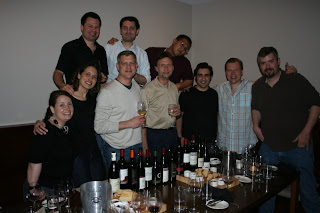
April 20th was a special day for me. It was the first wine event I’ve ever went to since I turned 21 not more than six days earlier. The gathering was at the Sonoma Wine Bar in D.C. with a bunch of Vayniacs from WLTV. Brad accompanied me to the BYOB; I brought a 2001 Chateau Larrivet- Haut Brion, which was the first legal wine purchase of mine on my birthday. Along with Brad’s 2005 Educated Guess, a Napa Cabernet I believe, there were 11 other bottles! The wine list went:
2001 Chateau Larrivet-Haut-Brion
2004 Justin Cabernet Sauvignon Reserve
Again, without making this too much of a tasting note, I’d like to point out some wines I enjoyed throughout the night. One of the tasters, Patrick, commented that the Bordeaux I brought was the wine of the night. I loved it as well, as it had a bit of age to it that gave it a nice old-world but still fruit-forward, solid structure. The Elizabeth Spencer Cabernet Sauvignon was amazing as well. The fruit was the star in that wine, and it was a very classic example of winemakers letting the fruit serve its purpose and not manipulating it. The Alois Lageder Legrein was the most interesting of the night; it had a very barnyard nose but a very fruit-forward taste.
The Kim Crawford SB tasted like Welchs’ Grape Juice to me… Very sweet and not very enjoyable. The Justin Cabernet also seemed a bit of a fruit-nuke. One taster pointed out that the Saint Cosme Cote du Rhone had a “orange peanut circus candy” to the nose- that was the call of the night!
-Tatum